

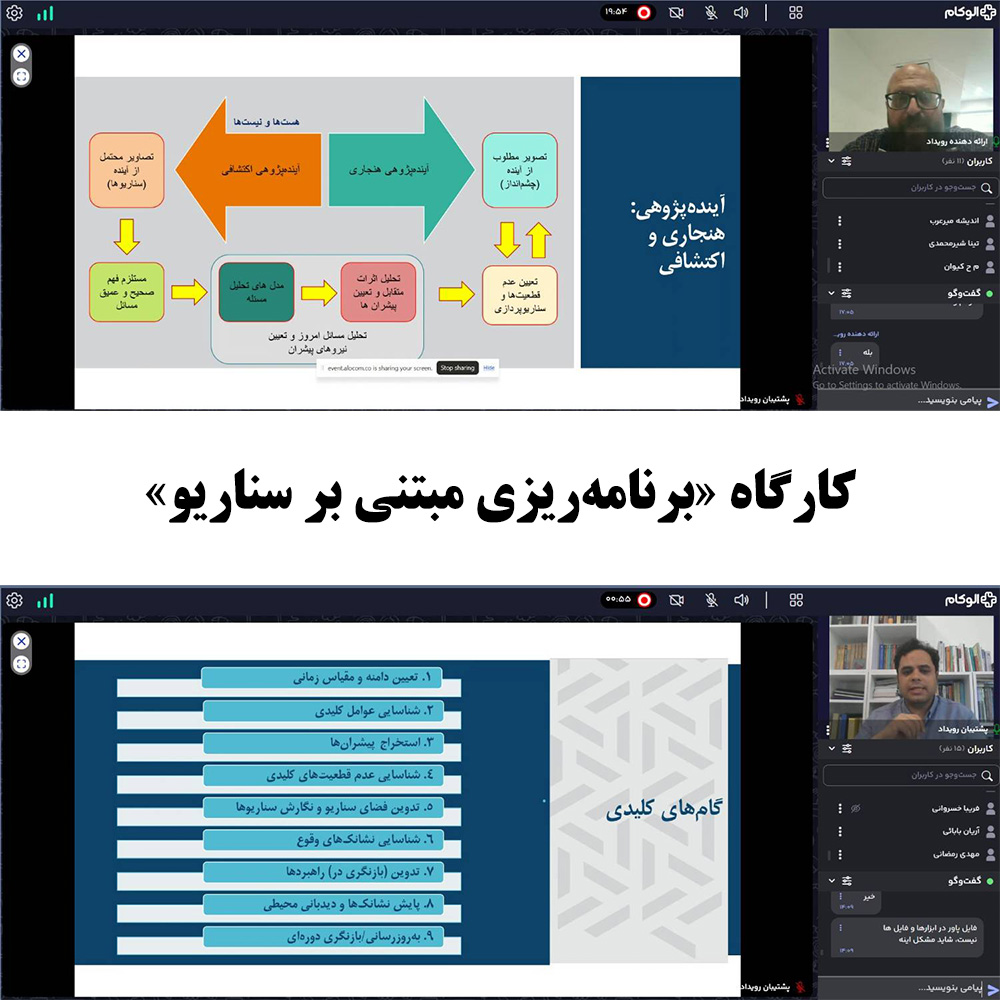
The Venture Capital Association, in collaboration with the Farda Development Foundation, recently hosted a specialized workshop on “Scenario-Based Planning,” attended by a group of managers in the fields of investment, innovation, and business development. The event was led by Maziar Attari, futurist and CEO of the Farda Development Foundation, and Yasser Khoshnevis, the Foundation’s Foresight Program Manager, focusing on the practical applications of scenario planning in strategic decision-making.
Why Scenario Planning?
At the outset of the workshop, the instructors highlighted the characteristics of today’s business environment—volatility, uncertainty, complexity, and ambiguity (VUCA). They emphasized that relying on linear forecasting and the assumption of trend continuity is no longer sufficient for modern management. In such a climate, scenario-based planning serves as a vital approach for preparing organizations to navigate diverse and probable futures.
Key Learning Outcomes
During the workshop, participants explored four core areas:
1. Understanding the Distinction Between Forecasting and Scenario Planning
Scenarios are not predictions of the future; rather, they are coherent and plausible narratives of possible futures. These narratives help managers challenge their underlying assumptions and prepare for a variety of potential outcomes.
2. Identifying Drivers and Key Uncertainties
Participants learned how to identify critical factors impacting their businesses, isolate key uncertainties, and construct a framework for designing a scenario matrix.
3. Designing Practical Scenarios for Decision-Making
The step-by-step process of scenario development—from defining scope and time horizons to crafting plausible narratives and extracting associated opportunities and threats—was explained in detail. The concept of “early warning indicators” for monitoring environmental changes was also introduced.
4. Translating Scenarios into Strategic Actions
In the final session, the focus shifted to developing contingency strategies for each scenario, as well as identifying “robust” strategies—those that remain effective across the majority of probable futures.
International Insights and Practical Application
By reviewing international case studies, such as Shell’s experience during the 1970s oil crisis, the instructors demonstrated that the true value of scenario planning lies in enhancing organizational preparedness and the quality of strategic decision-making, rather than attempting to precisely predict the future.
The workshop concluded by emphasizing the necessity of continuous environmental monitoring, periodic scenario reviews, and tracking signals of change—a methodology that has become an essential requirement for effective investment management and business development in today’s rapidly evolving landscape.


No comment